



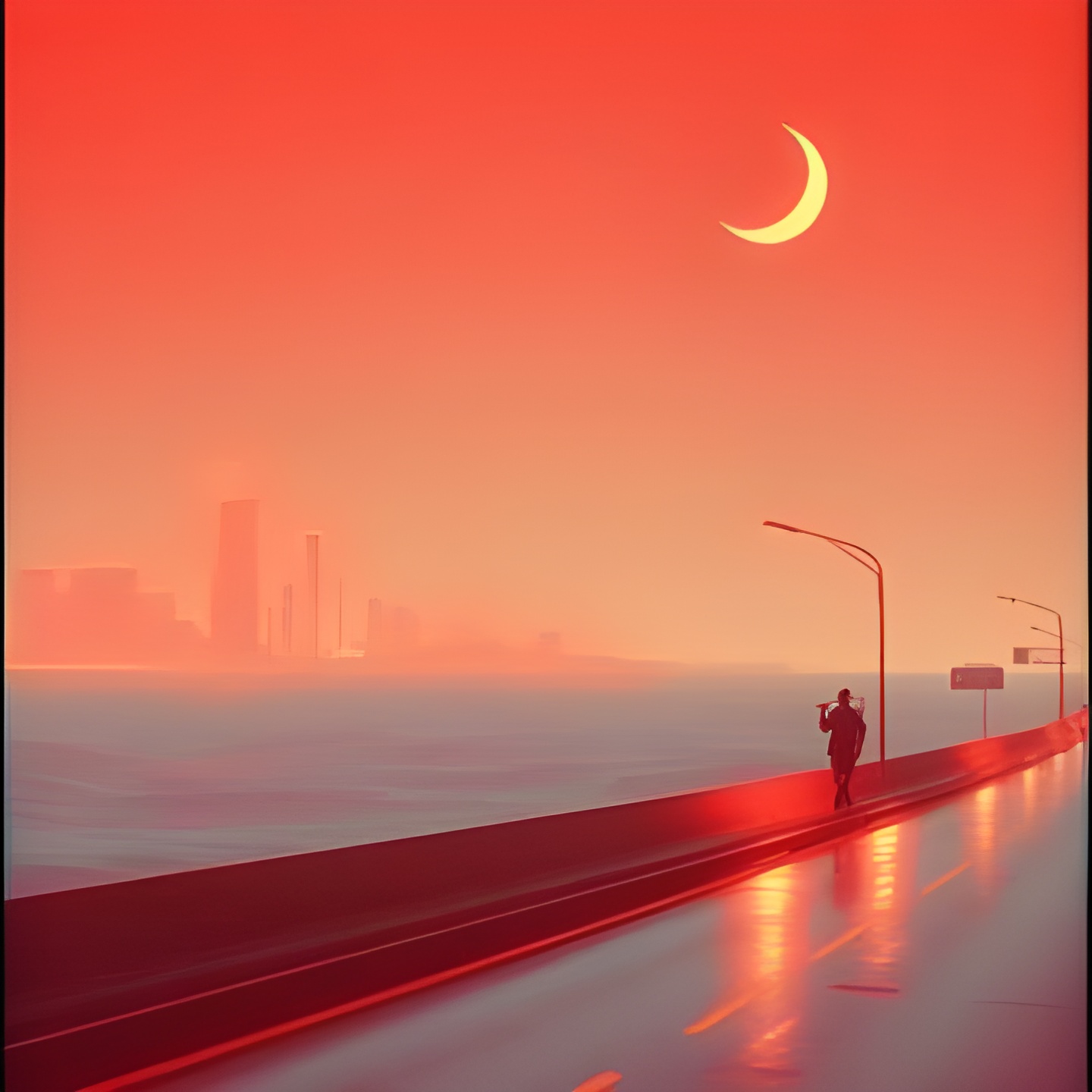




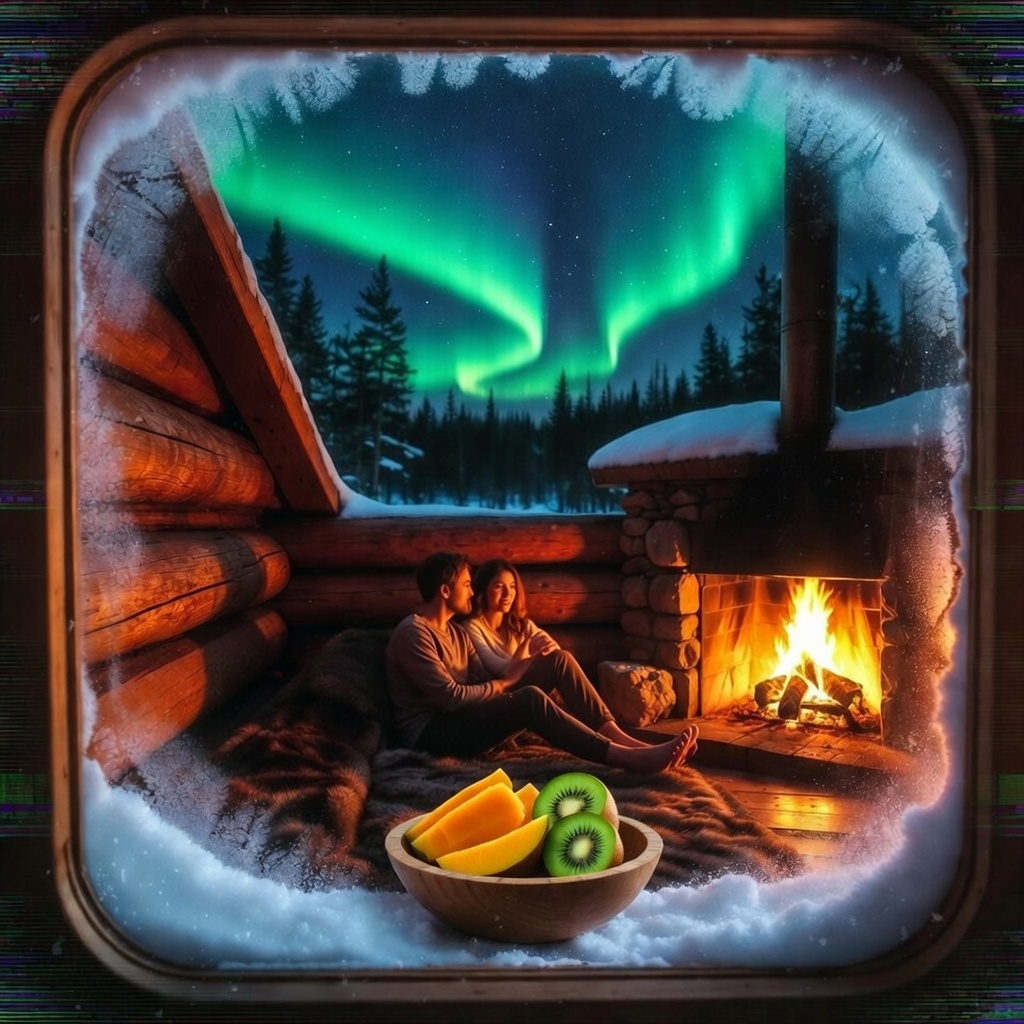
Some songs begin as images before they become words. “Forest Cabin” started with a single picture I couldn’t shake. It showed two people suspended inside a small pool of warmth. Winter pressed against the glass outside.
Lyrics
The cabin floats in fields of white
The cabin drifts in drifts of white
Adrift where northern forests sigh
Adrift where northern firs confide
The timber ticks, the embers bite
The logs click soft, the embers flare
Small orange stars that spark and die
Small fierce sparks that flare and slide

Snow slides slow past the windowpane
We stay still, we stay calm and mild
The fire breathes a low refrain
And time lies down, beguiled

We sink into the fur-lined floor
We sink, we blend in fur-lined deep
Bare feet tracing seams in pine
Bare feet trace the pine’s warm grain
Between us rests a wooden bowl
Between us rests the wooden keep
Mango gold and kiwi lime
Mango gold and kiwi’s green refrain

The wide world bends, the edges blur
Till this small flame is all we know
A slice of mango, sugar-sweet and warm
Hearthlight hums a velvet glow

Aurora stitches green through black
Aurora stitches jade through pitch-black seam
Silk-lit waves across the night
Silk waves shimmer, silent, bright
The glass looks back, reflects us back
The glass stares back, reflects our dream
Cold outside, but warm in light
Cold beyond, but here we’re light

Beyond these pines, beyond the snow’s embrace
Static and sirens blaze across the space
A thousand voices clamor, clash, and dash
They’ll go on fine without us this time

The wind hums hymns to frozen pines
The wind hums low through branches that twine
We’re the breath the storm ignores
We’re the sigh the tempest skips and spurns
Hands align; the moment holds
Hands entwine; our lives unite, unfolds
Nothing’s asking for more
Nothing calls, and nothing burns.

I don’t want to wake from this
This hologram of flicker, flesh, and bliss
Let the flames forget to dim and miss
Let the quiet settle in

Our shoulders meet
The green lights roll
No words remain to speak
Just warmth against the cold
Just warmth against the cold
The screen flickers over to the third SoundCloud track. The pulsing pop synths of the previous song recede, replaced by a minimalist, acoustic-ambient landscape. Soft male and female vocals overlap and drift through the speakers. They repeat and echo each other over the sound of a crackling fire. As the final line—”Just warmth against the cold”—fades into a gentle hiss of static, a heavy silence falls over the parlor.
Artie: (Leaning back in his armchair, crossing his legs with a dry smirk)
Well, well. Our anonymous internet troubadour has discovered the “Lo-Fi Chill Beats to Study/Relax To” aesthetic. The call-and-response structure is so repetitive it borders on hypnotic—or sleep-inducing, depending on how much coffee you’ve had. “The logs click soft, the embers flare / Small fierce sparks that flare and slide.” It’s practically a rewrite of a mid-tier Robert Frost poem. And then, right in the middle of this cozy, snowy, boreal cliché… they throw in mangoes and kiwis? Tropical fruit in a Siberian cabin? The logic is entirely broken.
Bea: (Eyes narrowing slightly as she sets her vape down)
No, Artie, you missed the entire turn of the phrase at the end. It isn’t a boreal cliché—it’s a simulation. “This hologram of flicker, flesh, and bliss.” The tropical fruit is the precise, intentional glitch in the matrix. It’s a hyper-virtual pastoral. This isn’t a song about a real cabin; it’s a song about two people escaping a dystopian reality—the “static and sirens”—by plugging into an idealized, digital sanctuary. The repetition in the lyrics isn’t lazy; it’s the sound of code looping. It’s an incredibly eerie, beautiful piece of text about manufactured comfort.
Gully: (Nodding slowly, unexpectedly quiet)
I… actually didn’t hate the production on this one. It’s the first time this artist has let the music breathe. Those acoustic textures sound remarkably organic, even if they are mimicking a digital environment. The way the male and female vocals weave in and out of each other—like they’re whispering under a blanket—has a genuine warmth to it. It’s got that early 2000s indie-folk intimacy. If you put this on a 10-inch milky-clear vinyl, it would sell out its first pressing on atmosphere alone.
Dex: (Frantically scrolling through his phone)
Forget vinyl, Gully, this is an absolute mood-board masterpiece. The visual imagery is insane. “Aurora stitches jade through pitch-black seam.” Do you know how many aesthetic Pinterest boards and atmospheric YouTube loops are going to use this track? It’s pure escapism for a generation that is constantly online and completely burnt out. The lyric “They’ll go on fine without us this time” is basically the ultimate anti-FOMO anthem. It’s going to be shared by every burnt-out tech worker from San Francisco to Tokyo.
Chloe: (Leaning back, tapping her pen against her chin)
It’s a masterclass in streaming architecture, Dex. The track is designed to be left on repeat. It doesn’t have a jarring hook like “Action Heroes,” but it has an incredibly high “stickiness” factor. It wraps around you like an acoustic weighted blanket. From a playlisting perspective, this fits seamlessly into “Chill Indie,” “Late Night Acoustic,” or “Idyllic Electronic.” This artist is showing a terrifying amount of range. Symphonic metal, cinematic pop, and now ambient indie-folk? They’re chameleonic.
Silas: (Adjusting his glasses, a faint smile on his face)
The repetition of lines with slight variations—“The cabin floats in fields of white / The cabin drifts in drifts of white”—is actually a traditional structural technique found in ancient Nordic and Slavic folk poetry, used to simulate the rhythmic, monotonous passage of winter. But the artist marries that ancient folk cadence with a distinctly modern, sci-fi existential dread. And look at the continuity! In track one, they stay in the stars. In track two, the heroes stay in the heart. Here, they stay inside the hologram to escape the chaos outside. “We stay… we stay… we stay.” It’s a trilogy of isolation and survival.
Artie: (Grudgingly pouring himself another splash of cold espresso)
Fine, so it’s a beautifully written, conceptually unified piece of existential dread masquerading as a cozy winter playlist. But I still find the lack of a proper bridge offensive. They just drift away into the digital ether.
Dex:
That’s because there is no exit, Artie! You just press play again.
Bea: (Looking back at the screen)
A beautifully gilded cage. I detest how much I actually want to go inside it.
Links